What number comes before 2?
Think about it for a moment... at first glance the answer seems obvious: the number 1!
If we are talking about integers, that is exactly right. But once we step into the vast world of real numbers, things change radically.
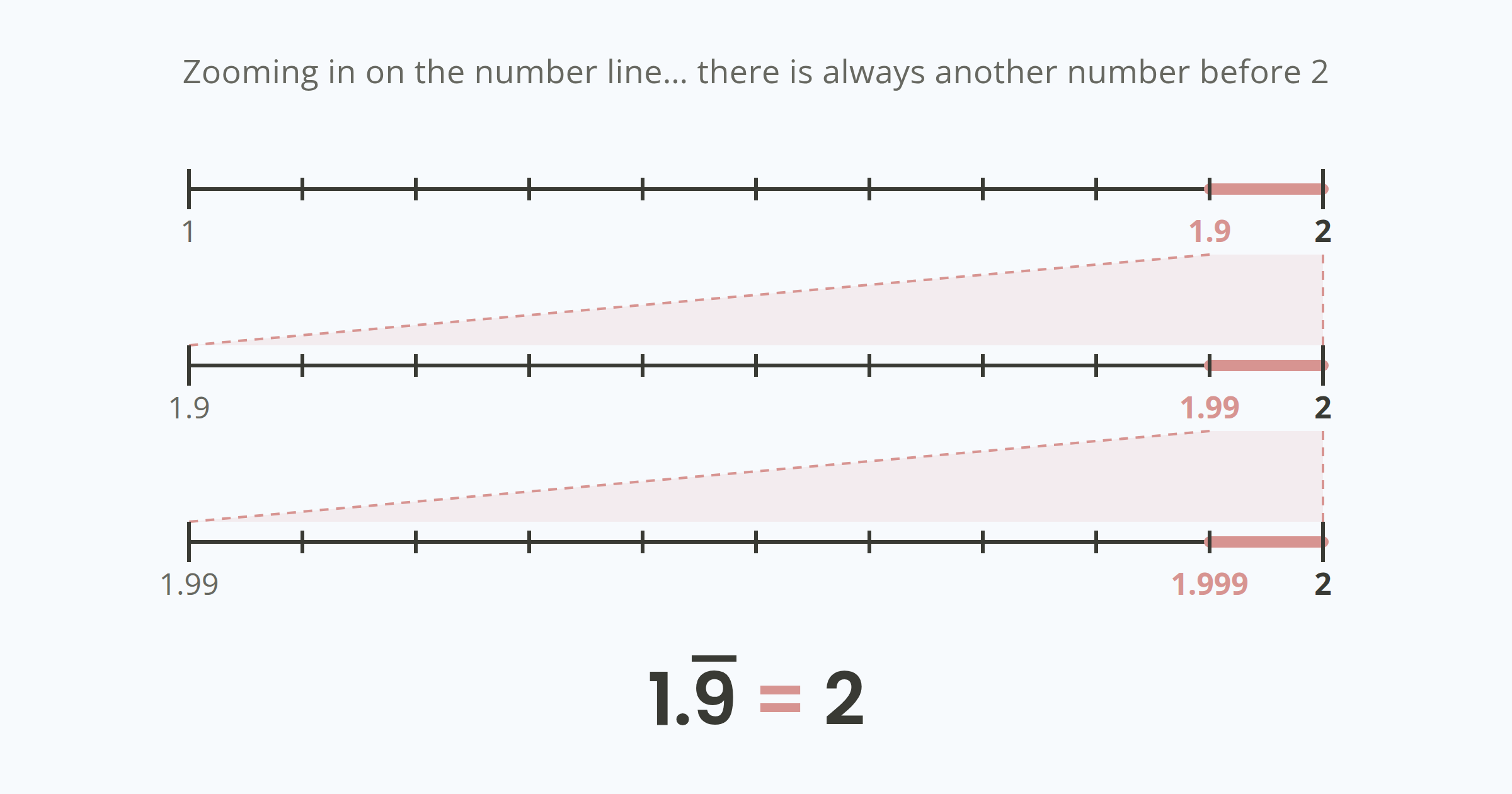
You might think of 1.9, 1.99 or maybe 1.999... but in mathematics numbers have a fundamental property called density: between any two different numbers there are always infinitely many others. Imagine a number line where, no matter how far you "zoom in", you always find new values. So there is no number that comes "right before" or "right after" another one.
The illusion of a gap
Intuition suggests that between the number 1.9 (1.9 repeating, that is, a 1 followed by infinitely many 9s) and the number 2 there is a tiny, "infinitesimal" gap, almost like a minuscule hole in the fabric of numbers.
But the mathematical reality is even more surprising: the real numbers are perfectly continuous and have no holes, and in standard analysis infinitesimals do not exist.
As a consequence, 1.9 is exactly equal to 2. There is no space between them: they are not two numbers very close to each other, they are simply two different ways of writing the very same quantity.
The proof (simpler than you think)
It is very easy to see once we look at what 0.9 (zero point nine repeating) is equal to. Follow these three logical steps:
- Think of a very famous fraction: 1⁄3 is equal to 0.3
- Now multiply everything by 3. The fraction 3⁄3 becomes equal to 0.9
- But we all know that 3⁄3 is exactly 1!
This shows unequivocally that 0.9 and 1 are two different representations of the very same number. They are not "close", they are literally the same thing written in two different ways!
And if 0.9 = 1, we just need to add the leading 1 to conclude that 1.9 and 2 are also the very same mathematical quantity.
Conclusion
In short, numbers can always be ordered by size, but in the world of real numbers continuity is complete and leaves no room for an absolute "predecessor". Mathematics teaches us that, sometimes, human intuition can be fooled by infinity.
Fascinating, isn't it?

Social links