Can the sum of infinitely many zeros be equal to 1?
We all know that if you have zero candies and add zero more, you are left with zero candies. But what if we added up an infinite number of zeros? Intuition screams that the result should still be zero:
0 + 0 + 0 + 0 + ... = 0
And yet, in mathematics, infinity loves to play nasty tricks on us. If we are not careful about the rules we use, we could find ourselves facing a real logical nightmare: we could prove that 0 is equal to 1!
Let's see how this fascinating mathematical "scam" is built.
The magic trick, step by step
Let's start from our infinite sum of zeros:
0 + 0 + 0 + 0 + ...
Step 1: We know that 0 can also be written as (1 − 1). So let's replace every zero with this little subtraction.
(1 − 1) + (1 − 1) + (1 − 1) + ...
Step 2: Now let's apply a rule we learn in elementary school, the associative property. This property tells us that in a sum we can move the parentheses however we like without changing the final result. So let's shift our parentheses one place to the right, leaving the first 1 alone outside:
1 + (−1 + 1) + (−1 + 1) + (−1 + 1) + ...
Step 3: Let's work out the operations inside the new parentheses. Obviously, (−1 + 1) is 0. Substituting:
1 + 0 + 0 + 0 + ...
Conclusion: Setting aside the initial 1, we are left with just an infinite sum of zeros (which is zero). So the final result is 1. We have just "proved" that:
0 = 1
That is definitely something to worry about! If 0 were equal to 1, the whole of mathematics would collapse in on itself. Computers would stop working and banks would be thrown into chaos.
Revealing the trick: where did we go wrong?
Don't throw away your math books: there is a mistake, and it is a very subtle one.
The trick is hidden in Step 2. We used the associative property, moving the parentheses around casually. The problem is that the associative property does not always hold for infinite sums!
It works perfectly if you are adding three, ten or a million numbers. But when you push all the way to infinity, the rules change. The series we created (known as Grandi's series: 1 − 1 + 1 − 1 + ...) has no precise limit: it keeps "bouncing" forever without ever settling on a final value (in jargon, we say that it does not converge).
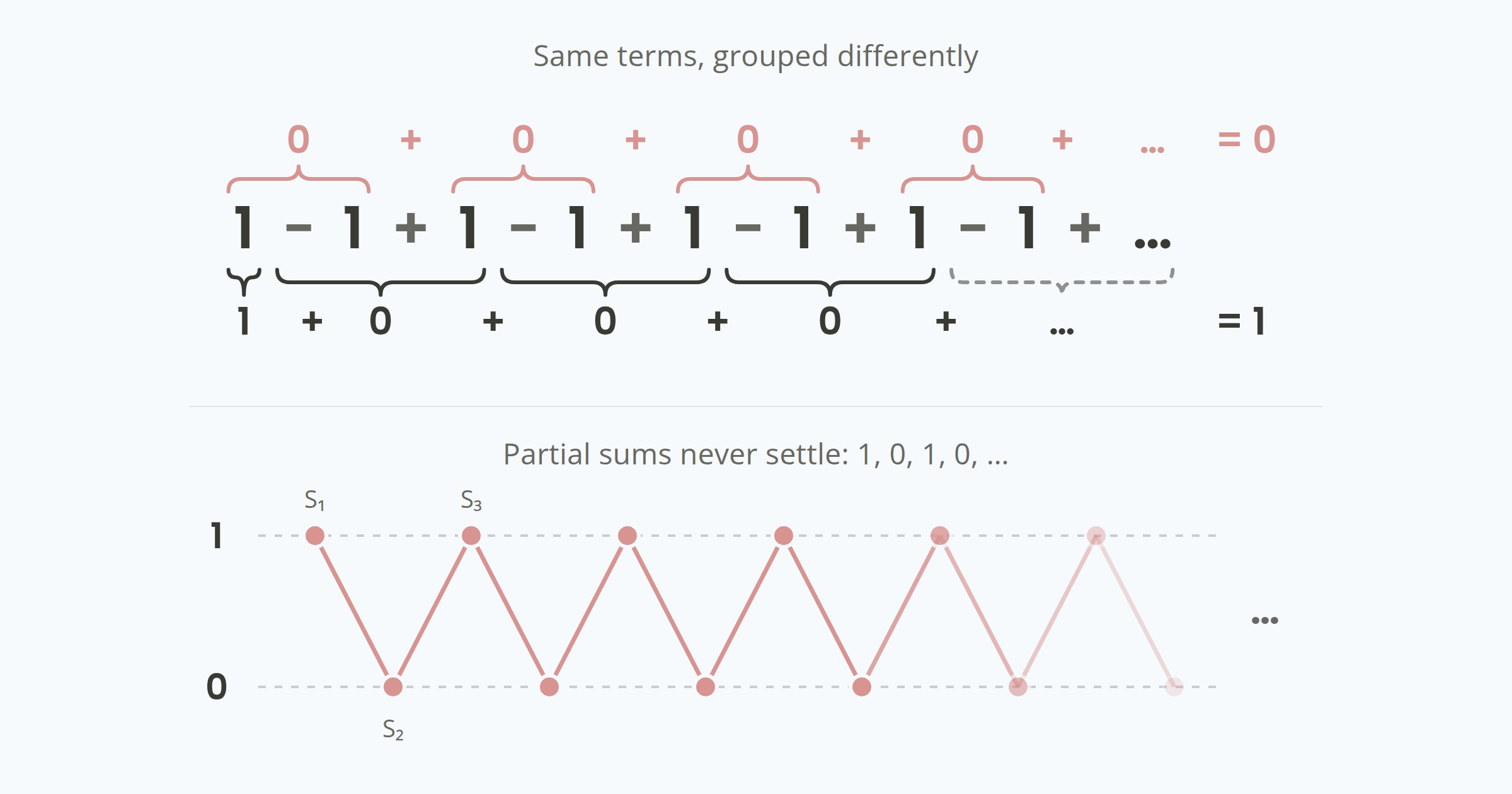
When you are dealing with infinite series like this one, moving the parentheses is an illegal move. By doing it, you are forcing mathematics to give you the wrong answer.
Conclusion
Infinity is not a number like the others; it is a wild beast that has to be tamed with special rules (those of mathematical analysis). Applying the rules of basic arithmetic to infinity is like trying to fly a plane using a bicycle manual: sooner or later, you end up crashing into a paradoxical 0 = 1!

Social links