Achilles, the Tortoise and the Magic of Infinite Sums
Imagine a race between the legendary Greek hero Achilles, famous for his speed, and a slow tortoise.
To make the challenge fair, Achilles gives the tortoise a 100-meter head start. Logic tells us that Achilles will overtake the animal in the blink of an eye, right? And yet, in the 5th century BC, the philosopher Zeno of Elea came up with a paradox that seemed to prove the exact opposite: Achilles will never catch the tortoise.
The paradox
Follow Zeno's reasoning:
- Achilles starts running to cover the 100-meter gap.
- In the time it takes Achilles to reach that point, the tortoise, however slowly, will have moved forward, say by 10 meters.
- Achilles now has to cover these 10 meters, but in the meantime the tortoise will have moved forward by another meter.
- Achilles runs that meter, but the tortoise will have gone another 10 centimeters further.
Every time Achilles reaches the point where the tortoise was a moment before, it has moved a little bit further. This process repeats forever. Since there are infinitely many little "pieces" of distance to cover, Zeno concluded that it would take an infinite amount of time. Achilles is doomed to chase it forever!
The deception of infinity
Zeno's reasoning is fascinating, but where is the mistake? The intuition that fools us is a belief deeply rooted in the human mind: we believe that adding up infinitely many quantities (even tiny ones) must necessarily give an infinite result.
But mathematics teaches us that this is not the case!
Let's step into the magical world of convergent series. In mathematics, it is perfectly possible to add up infinitely many numbers and get a finite result.
The infinite cake (and the math that saves Achilles)
Let's take a very simple visual example to dismantle the paradox. Imagine you have to eat a whole cake.
- First you eat half of it (1⁄2).
- Then you eat half of what is left, that is, a quarter (1⁄4).
- Then again half of the rest, an eighth (1⁄8).
- And so on, forever: 1⁄16, 1⁄32, 1⁄64...
You are cutting infinitely many slices, each smaller than the last. If we add up all these infinitely many fractions:
1⁄2 + 1⁄4 + 1⁄8 + 1⁄16 + ... = 1
The total is exactly 1 whole cake! You don't need an infinite stomach to eat it.
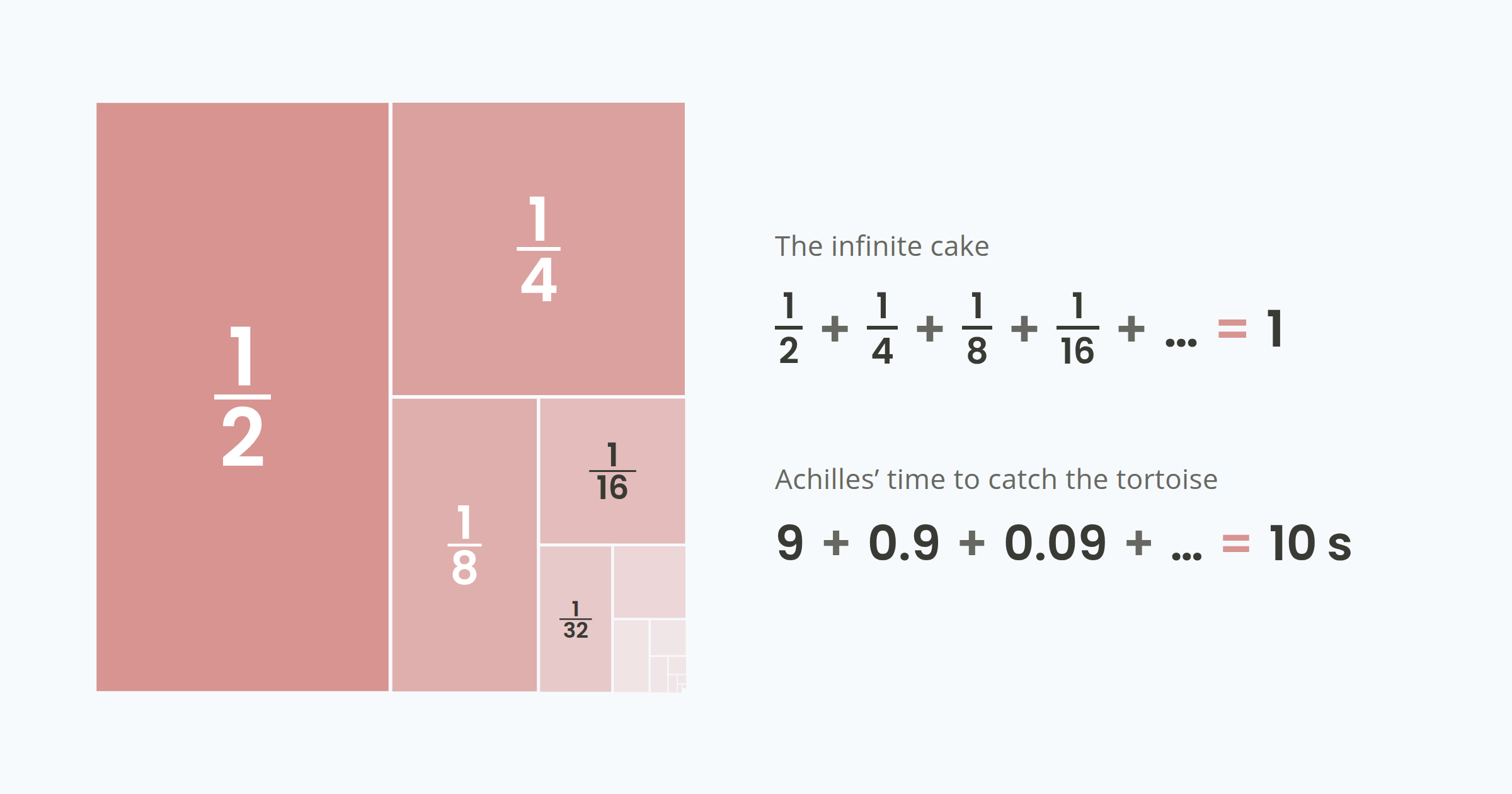
The same principle applies to Achilles. It is true that he has to take infinitely many "tiny steps" to reach the tortoise, but the time it takes him to complete each tiny step gets smaller and smaller, exactly like the slices of cake.
The sum of the infinitely many time intervals Achilles needs is a finite quantity. For example, it might take only 10 seconds in total. After those 10 seconds Achilles is level with the tortoise and, by second 11, he has already overtaken it by a wide margin.
Conclusion
Zeno's paradox remained a philosophical puzzle for centuries, until mathematics provided the rigorous tools to understand infinity. Infinite sums teach us that our brain is not always equipped to grasp how the universe works, but mathematics gives us the right lens to see clearly.
In the end, Achilles always wins his race.

Social links